The Plate That Will Not Exist Tomorrow: An Ephemeral Evening at Sushi Masa by Ki-setsu
A Counter That Listens to the Sea
The room does not ask for your attention; it waits for it.
There is a specific quality of silence that exists in spaces where nothing is superfluous. You find it in darkrooms before the safelight clicks on, in the pause between movements of a symphony, and here, on Level 6 of Cuppage Plaza. The door closes behind you, sealing off the humidity of Singapore and the electric hum of the city, leaving only a pale, clean stillness.
There are eight seats. That is all. The counter is smooth, unvarnished wood—a blank canvas that reflects the soft, directional light above it. As a photographer, I am drawn to spaces like this, where the visual noise has been turned down so low that the slightest movement registers as a major event. In this room, the cutting of a fish is not a prep task; it is a gesture as significant as a conductor raising a baton.
I have come here not to eat, in the utilitarian sense, but to witness something that is disappearing. In my work, I chase light that changes by the second. Here, Chef Masa chases ingredients that change by the hour. We are both in the business of capturing things that refuse to stay still.
The Discipline of Saying No as a Form of Presence
In photography, the edit is often more important than the shoot. It is the discipline of saying no—no to the distraction, no to the clutter, no to the image that is merely “good enough”—so that the single, truthful frame can emerge.
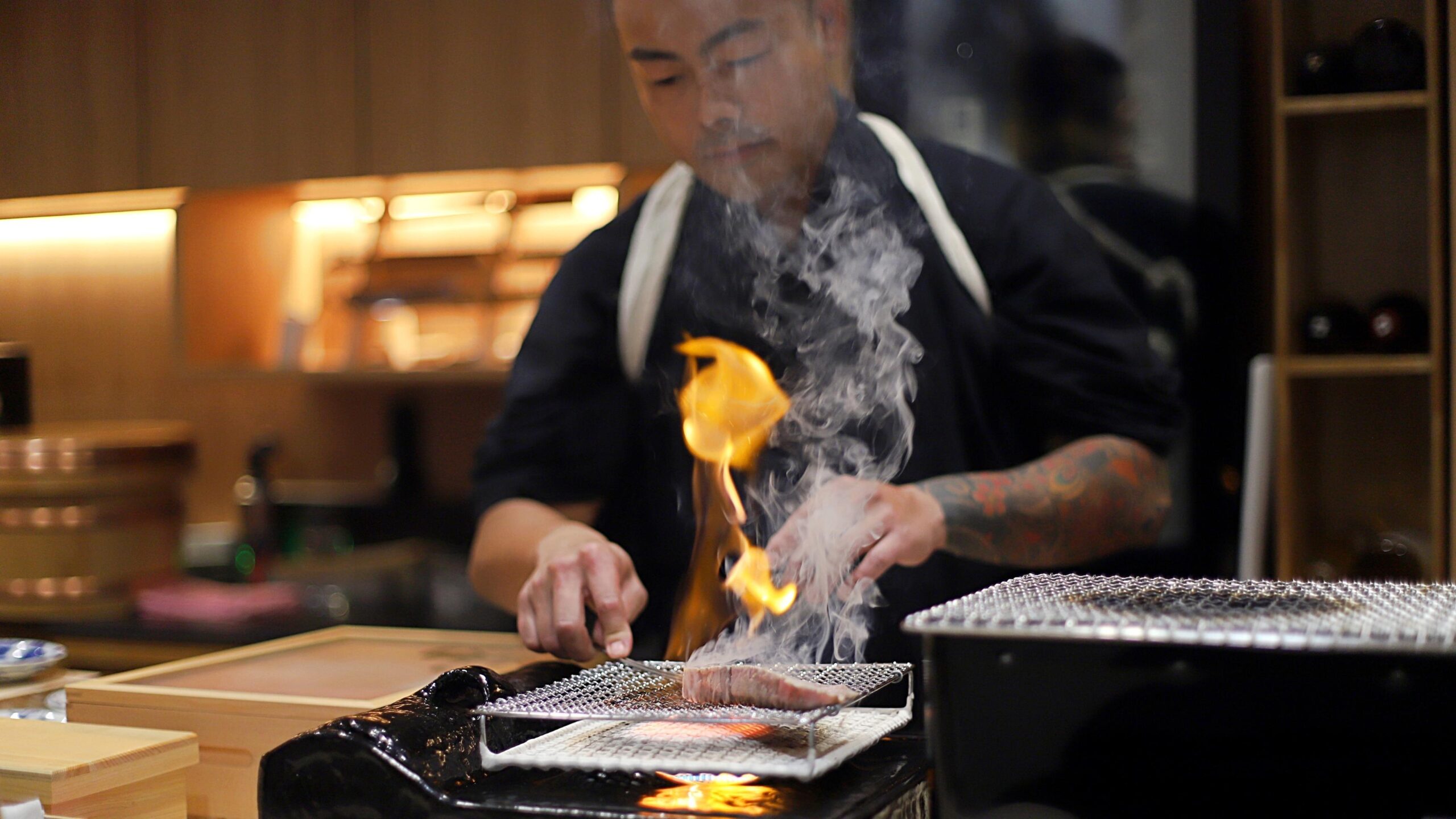
Chef Masa operates by this same ruthless, beautiful discipline. In a culinary landscape obsessed with scaling up, franchising, and replicating success, he has chosen the radical path of contraction. He refuses to expand. He refuses to hand over the knife to a sous chef. He remains here, night after night, standing behind this intimate counter, personally preparing every course for just eight people.
This refusal is not a business strategy; it is a philosophical stance. It is the understanding that one cannot be fully present for eighty people. To see deeply, one must narrow the field of vision.
The menu is a ghost. It appears in the morning and vanishes by midnight. Because ingredients are flown in daily from Toyosu Market in Japan, the 16-plus course omakase—priced at $230+ or $320+ per person—is never a rehearsal of yesterday’s performance. It is rebuilt from scratch, dictated entirely by what the ocean has yielded that specific dawn.
As I watch him work, I recognize the solitude of the craftsman. There is no safety net of a fixed script. If the aji (horse mackerel) arriving from Toyosu is slightly fattier today than yesterday, the cut must change, the vinegar in the rice must adjust.
He is improvising a symphony in real-time. It reminds me of shooting film—there is no “undo” button. You must be technically perfect, yet emotionally open to the accident of the moment.
The Morning the Menu Is Born
We often mistake consistency for quality. We want the burger to taste the same in Tokyo as it does in New York. But true quality is actually a submission to inconsistency—a surrender to the fact that nature is never static.
The restaurant’s name, Ki-setsu, means “season.” But in the Japanese culinary calendar, “season” is not a clumsy three-month block of Summer or Winter. It is a nuanced, shifting calendar of 72 micro-seasons, each lasting only five days.
A specific mountain vegetable, a particular shellfish, the exact fat content of a tuna belly—these things exist in their perfect state for a blink of an eye.
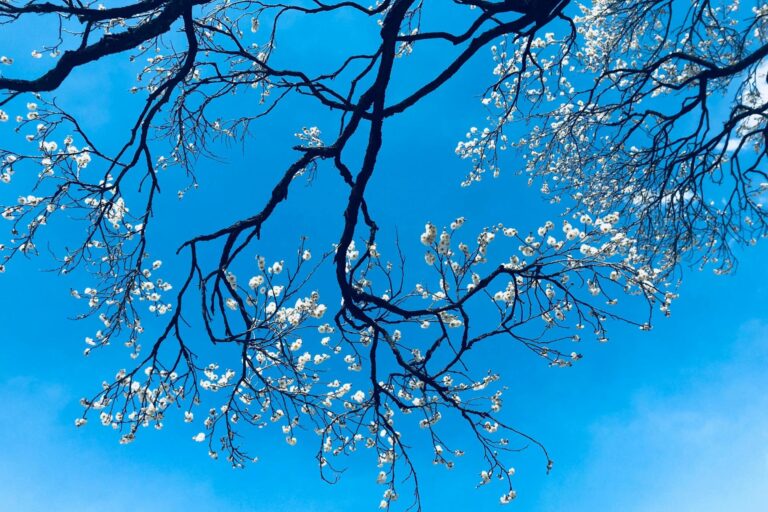
Chef Masa does not fight this finitude; he embraces it. Tonight, we might be eating in the micro-season of “Earthworms Rise” or “First Peach Blossoms.” The plate set before me is a marker of time.
This is where the experience transcends dining and becomes a meditation on impermanence. When I lift a piece of nigiri to my mouth, I am acutely aware that I am consuming a moment that cannot be repeated.
The fish will never be this age again. The rice will never be this temperature again. The chef will never cut it with this exact breath again.
It is a feeling akin to watching a sunset or a cloud formation. You cannot hold it. You can only be present for it.
Eight Witnesses to a Singular Evening
The intimacy of the room is confronting. With only eight seats, there is nowhere to hide. You are not a customer; you are a witness.
The counter acts as a conduit for a silent, intense dialogue between chef and guest. Chef Masa watches us as closely as we watch him. He notices if you are left-handed and places the sushi accordingly, angled for your dominant grip. He notices if you are eating quickly or slowly, adjusting his tempo to match your breath.
This mutual attention creates a rare quality of presence. In a portrait session, there is a moment when the subject stops posing and simply is. That moment requires trust. It requires time. Here, over the course of two to three hours, that same trust develops.
We surrender our choices to him—there is no ordering, only receiving—and in return, he gives us his absolute attention.
It explains why bookings must be made weeks, sometimes months, in advance. It is not artificial scarcity; it is the necessary cost of this level of engagement. You cannot franchise a soul. You cannot scale presence.
The Rice Cools. The Moment Passes.
Dinner is served only from Tuesday to Saturday, with private bookings on Sundays and a day of rest on Mondays. The scarcity of the seats mirrors the scarcity of the ingredients.
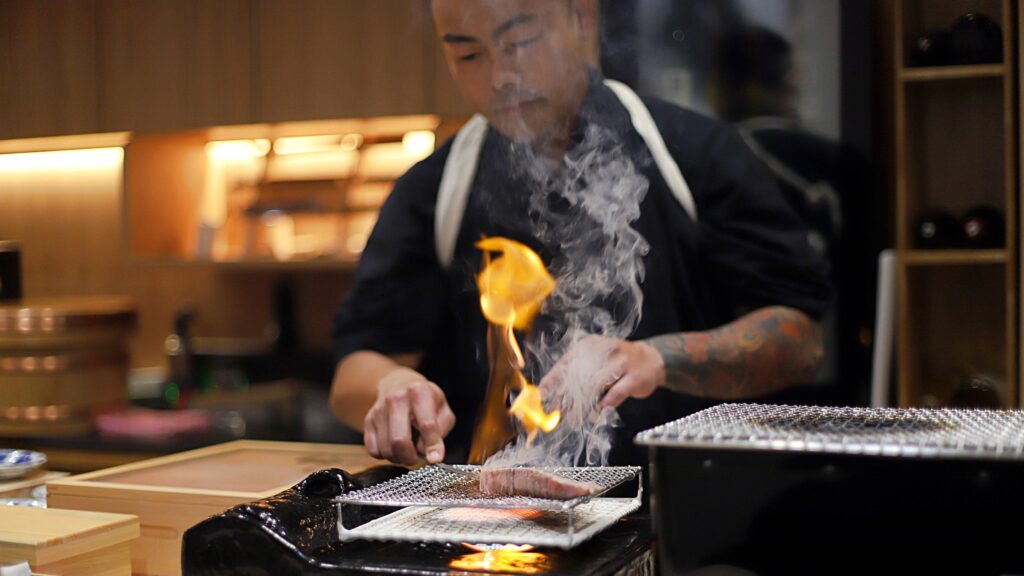
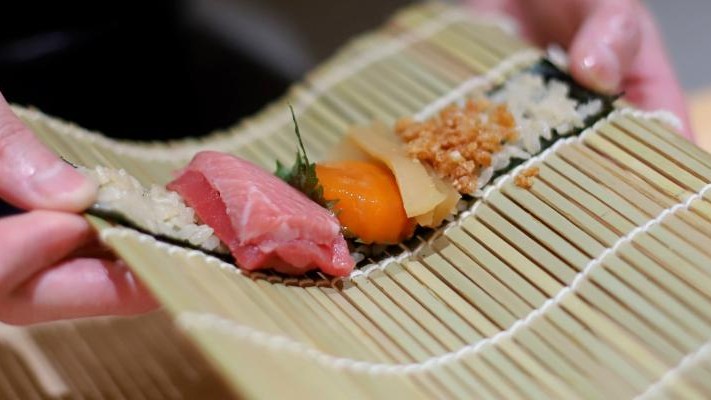
Towards the end of the meal, the pace slows. The procession of courses—cold, warm, grilled, simmered—begins to feel like a narrative reaching its denouement. I watch the chef’s hands, moving with an economy of motion that borders on prayer. He forms a piece of sushi, the rice cradling the fish with just enough air between the grains to let it breathe.
He places it on the plate. “Only for now,” the gesture seems to say.
I hesitate before eating. As a photographer, my instinct is to freeze time, to preserve the image. But some things are not meant to be saved. They are meant to be experienced and then let go. The rice is cooling. The oils in the fish are melting. The window of perfection is closing.
I eat the sushi. It is profound, complex, and then—it is gone.
On Witnessing Something That Has Already Gone
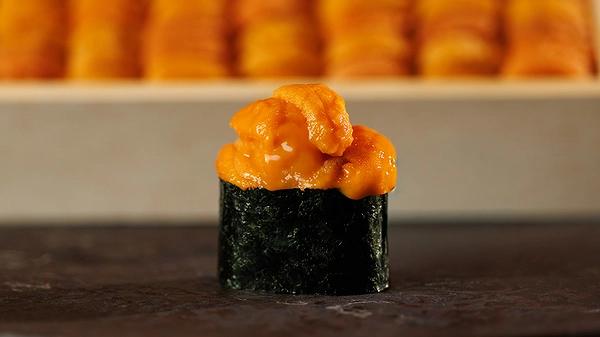
We leave the restaurant and step back into the humidity of Cuppage Plaza. The spell breaks, as it must.
People ask me why I shoot documentary photography, why I bother recording things that will eventually fade. I do it because the act of noticing validates the existence of the thing.
Dining at Sushi Masa by Ki-setsu is a similar act. It is a commitment to notice. The weeks of waiting for a reservation are not an inconvenience; they are the long exposure, the gathering of light required to capture an image in a dark room. They are the preparation we need to slow down enough to truly see what is placed in front of us.
Tonight’s meal will never exist again. The menu has already dissolved. Tomorrow, the plane will land from Toyosu with new boxes, new textures, new demands. But for a few hours, in a quiet room on the sixth floor, eight of us were there. We witnessed the season. We tasted the time. And that is enough.
To learn more about the art of fermentation and the mastery behind Japanese koji, visit this article.